







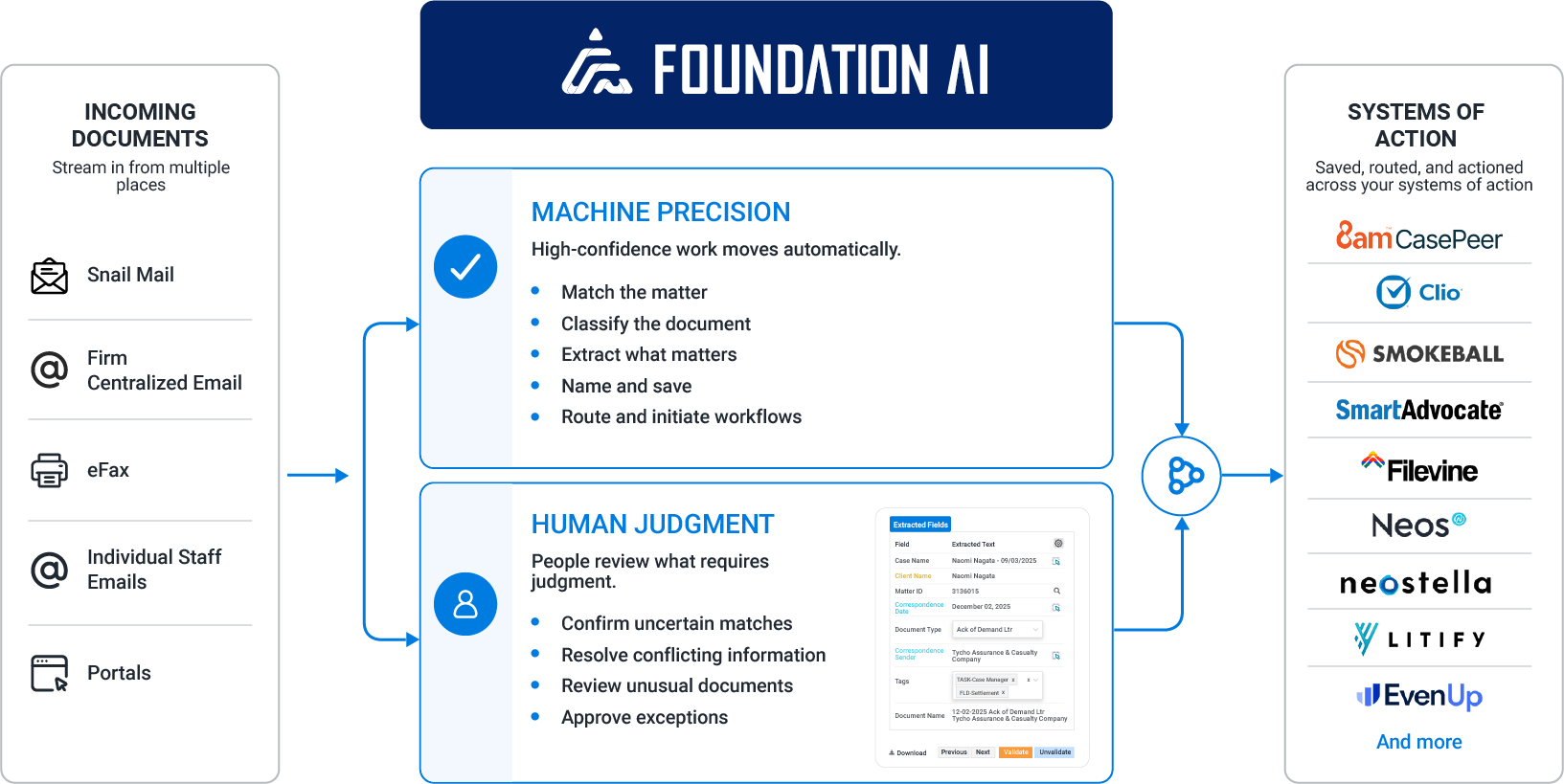
Foundation AI brings every incoming document, including physical mail, e-fax, portal downloads, and email attachments into one standardized workflow the moment it arrives.
At most firms, documents still arrive through individual inboxes. Every staff member becomes another potential point of failure. FAI’s Total Email Capture monitors designated accounts, captures matter-related third-party attachments, deduplicates documents sent to multiple recipients, and pulls each one directly into the platform for processing. The originating email is tagged in Outlook or Gmail, so staff know the attachment has already been captured, saved, and processed downstream.
General-purpose LLMs can look impressive in demos but silently fail in production. Categories overlap, taxonomies are hierarchical, and one document may require multiple labels. Classification may depend on details buried in the document, matter metadata, prior documents, or firm-specific rules. When a model is wrong, it can sound just as confident as when it is right.
Foundation AI combines fine-tuned LLMs, RAG, business logic, jurisdiction-specific taxonomies, deterministic guardrails, and proprietary methods to evaluate each document from multiple angles. The results are reconciled and calibrated into a confidence score for every field, so the platform knows when it is uncertain and what a human should review.
Getting the right matter is harder than it looks—and getting it wrong can be catastrophic. It’s not just picking a name or claim number from a table. Your firm has thousands of matters with overlapping names, missing identifiers, and complex relationships. A small error can misfile a document so that it never gets reviewed at all.
Foundation AI evaluates multiple signals including names, dates, addresses, and claim and policy numbers using custom models, RAG, vector search, and deterministic guardrails. It finds the right matter, then matches related contacts, providers, staff roles, Filevine collections, Salesforce objects, and other firm records. When confidence is low, it does not guess. Instead, it surfaces the most likely matches for your team to confirm.
Most document workflows were built for an analog world, then improved one step at a time. Even strong processes are impossible for people to follow consistently across inboxes, matters, and teams.
Foundation AI brings seven years of document-operations best practices, with specific models, taxonomies, and workflows for personal injury, workers’ compensation, SSDI, VA, property claims, bankruptcy, immigration, and more. The FAI Platform standardizes how documents are named, organized, routed, tasked, and prepared for what follows, then applies those rules every time. Firms can adopt proven workflows or use their own. Either way, each document flows into the right folders, records, tasks, workflows, and downstream systems, with a fraction of the effort and risk.
Foundation AI is built for human-empowered AI, with the intelligence to know when to ask for help.
Every match, classification, and extraction is evaluated against calibrated confidence thresholds. Confident results move straight through. When review is needed, the uncertainty is clearly highlighted in the FAI user interface, making review faster and the resulting data cleaner.
Instead of spreading tedious clerical work across case managers and paralegals, most firms centralize review with a lower-level operations team, freeing more expensive resources for higher-value work. The platform does not remove humans from the process. It removes the wrong work from humans—so firms get the speed of automation without giving up control.
People confirm what requires judgment. Foundation AI executes what requires consistency.
The best firms are not faster because people work harder. They are faster because their work is more standardized, more controlled, and less dependent on manual coordination.
Foundation AI provides system-enforced workflow orchestration. It applies firm-defined rules to route work to the right role, create tasks, set deadlines, trigger escalations, update downstream records, and alert the right people based on document content and context. Through supported integrations, FAI can automate downstream workflows like calendaring events and updating treatment and damages records. Correct execution no longer depends on rekeying data or remembering what comes next.
Though firms may have some visibility into centralized mail, they have far less visibility into documents arriving across individual inboxes and whether those documents were ever captured, processed, or filed correctly. When someone is out, overloaded, or behind, important documents can sit untouched with no reliable way for the firm to know.
Foundation AI makes document operations visible across the firm by tracking each document and every action taken within the platform, from capture, matching, classification, and validation through filing, routing, task creation, and delivery downstream. Built-in dashboards, custom reports, and feeds into Domo, Power BI, and other BI systems show what happened, what remains unresolved, and where attention is needed.
Foundation AI isn’t just AI-powered software; it’s human-empowered AI, with the intelligence to know when to ask for help. Your people confirm what required judgment, and Foundation AI executes what requires consistency. Foundation AI doesn’t remove humans from the process, it removes the wrong work from humans, giving firms the perfect balance of speed and control.






The best practice management system, reporting stack, generative AI tool, or legal team cannot do its best work with incomplete, unstructured, inconsistently handled documents.
The first mile is the hardest part of document-driven AI: capturing every document, understanding what it is, matching it correctly, standardizing it, and turning it into clean, reliable inputs for everything downstream.
That is where most internal builds, generic AI tools, and point solutions break. They may produce something convincing in a demo, but they do not solve the real operating problem: reliably turning messy real-world documents into structured, actionable data and work across an entire firm.
Foundation AI does. We focus exclusively on solving and improving that first mile—drawing on seven years of operationalizing millions of documents for hundreds of leading law firms. Your firm gets the benefit of a purpose-built platform, proven workflows, and better practices across every document that enters the business.